
Zeiss Ikon Kolibri
|
|
|
| Style, film format | Zone focus with collapsible tube lens taking 127 roll film |
|
|
|
| Lens, shutter | Uncoated f/3.5 5cm Tessar, Compur |
|
|
|
| Photo quality | Very good |
|
|
|
| Ergonomics | Read text |
|
|
|
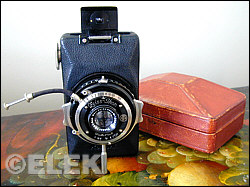
One book describes this as "the poor man's Leica." Of course, the same book describes half of the cameras as "the poor man's [insert either Leica or Contax here]."
This particular camera came from the Ukraine. It appeared on eBay several times over the course of a month, and finally I decided that I couldn't stand it any longer and purchased it.
Zeiss Ikon introduced this camera in the early 1930s, and supplied it with either the Novar or Tessar lens. This is just one of a few fixed-lens cameras that featured a collapsible tube, rather than bellows. Certainly, this lens style isn't unique, but it's somewhat uncommon.
Using the "ears" on either side of the lens, twist about five degrees, and the lens will pop out and snap into position. The camera's two-piece flip-up viewfinder is located on top of the camera and allows for the camera to be grasped lengthwise for horizontal shots.
Like many of the Zeiss Ikons, much attention was paid to design. The Kolibri is attractive with its sculpted shape. The rounded corners, which look great, can make the camera a bit tougher to hold. This camera is slightly different from other half-frame cameras in that the camera is held upright for landscapes and horizontally for portraits.
The truth is that I usually seem to have a tough time finding a comfortable way to hold the camera, especially for landscape shots. The viewfinder is the primary impediment, because it's located on the end of the camera -- an untraditional position.
The camera includes a small post that lets the camera stand upright. Another accessory is a very short cable release, though I've not found either it to be useful yet.
The camera takes 16 shots per roll. The Tessar lens is very sharp, just like most Tessars. It's a very capable camera..