
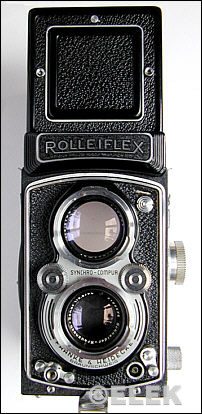
Rolleiflex Automat
|
|
|
| Style, film format | Twin-lens reflex, 120 roll film |
|
|
|
| Lens, shutter | Coated 75mm f/3.5 Schneider Kreuznach Xenar or Zeiss-Opton Tessar, Synchro-Compur |
|
|
|
| Photo quality | Excellent |
|
|
|
| Ergonomics | Image is laterally reversed in viewfinder |
|
|
|
This is one of the best classic cameras of all time. The Rolleiflex was the standard of news and studio photographers for decades until high-quality Nikons, Canons and Hasselblads arrived on the scene.
The twin-lens reflex is an easy camera to use, although the image is reversed laterally in the viewfinder.
The Automat was a further refinement of the original design created by Franke & Heidecke and brought to the market in 1929. The Rolleiflex continues in limited production today, predating many medium format cameras and outlasting all of them.
The Automat introduced a system that made the camera incredibly simple to load. Simply run the film between the two rollers, which automatically sense the start of the emulsion. It's quick and nearly foolproof.
These cameras came with either a Schneider-Kreuznach Xenar or Zeiss Tessar lens - both four-element optics know for their resolving power. Either is an excellent lens, and you'd be hard-pressed to tell the difference between the two. When shooting wide open and at close to medium distances, both lenses will give you round out-of-focus backgrounds. With the lens stopped down to f/8 or smaller, it's incredibly sharp.
Photos from the Rolleiflex can be enlarged to ridiculous sizes without any loss in quality. Because the Rolleiflex shoots a square image, there is no need to turn the camera.
The Rolleiflex is sturdy and reliable, rarely ever breaking down and able to withstand hard use, as long as you don't crack the viewing screen.
Most are now more than 50 years old, and often the only maintenance they require is a lens, mirror and viewfinder cleaning and routine maintenance to the shutter.
As I mentioned in my mini-review of the 3.5F model, a Rolleiflex is a camera for life.